Introduction: Why OKRs Matter for Team Alignment
Objectives and Key Results (OKRs) have become the gold standard for strategic goal-setting in high-performing organizations. Originally developed at Intel and popularized by Google, the OKR framework helps teams focus on what matters most by setting ambitious objectives and measuring progress through specific, quantifiable key results.
However, many teams struggle with OKR implementation because their goals remain disconnected from day-to-day work. Research shows that 70% of employees don't understand how their daily tasks contribute to company objectives, leading to misaligned priorities and wasted effort.
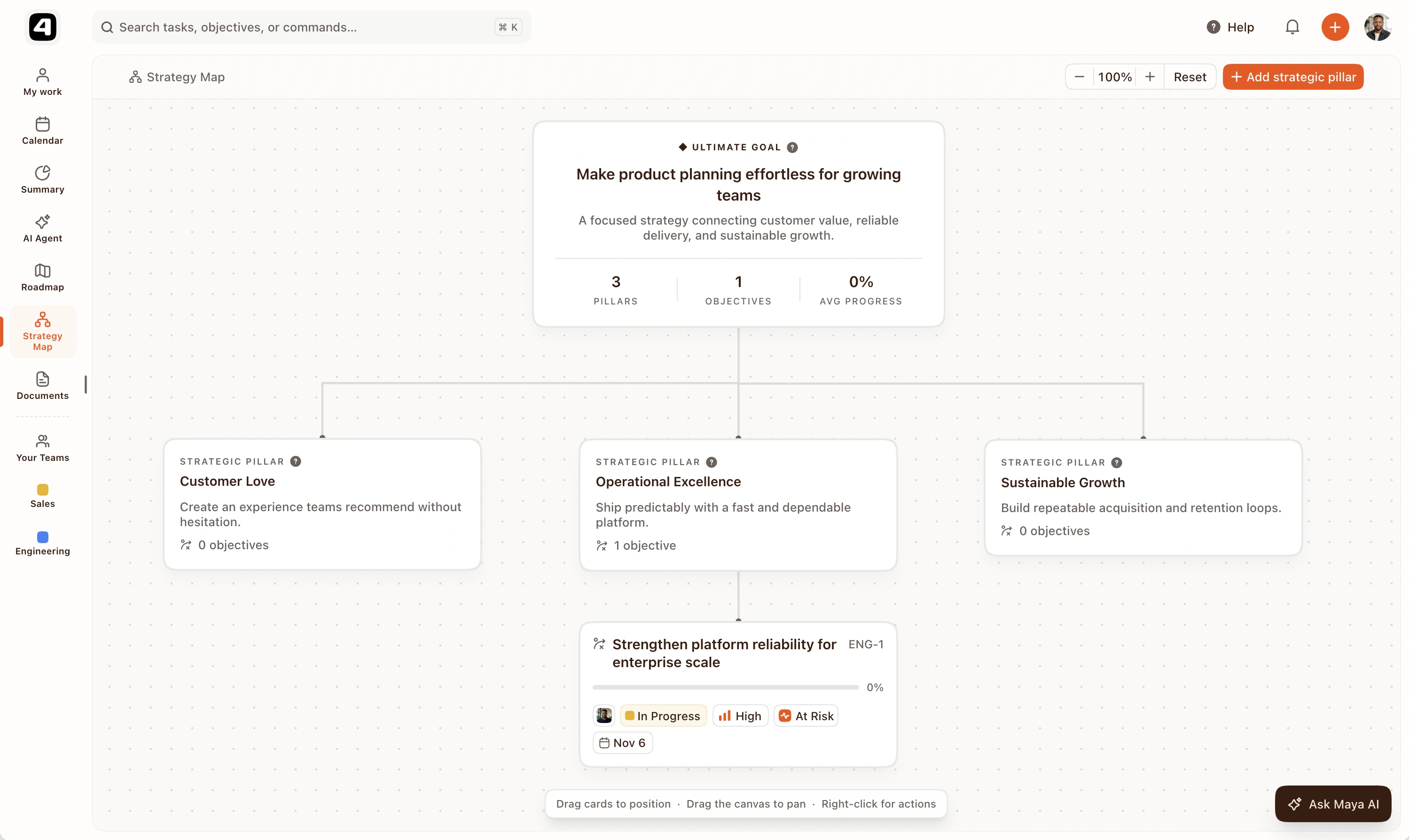
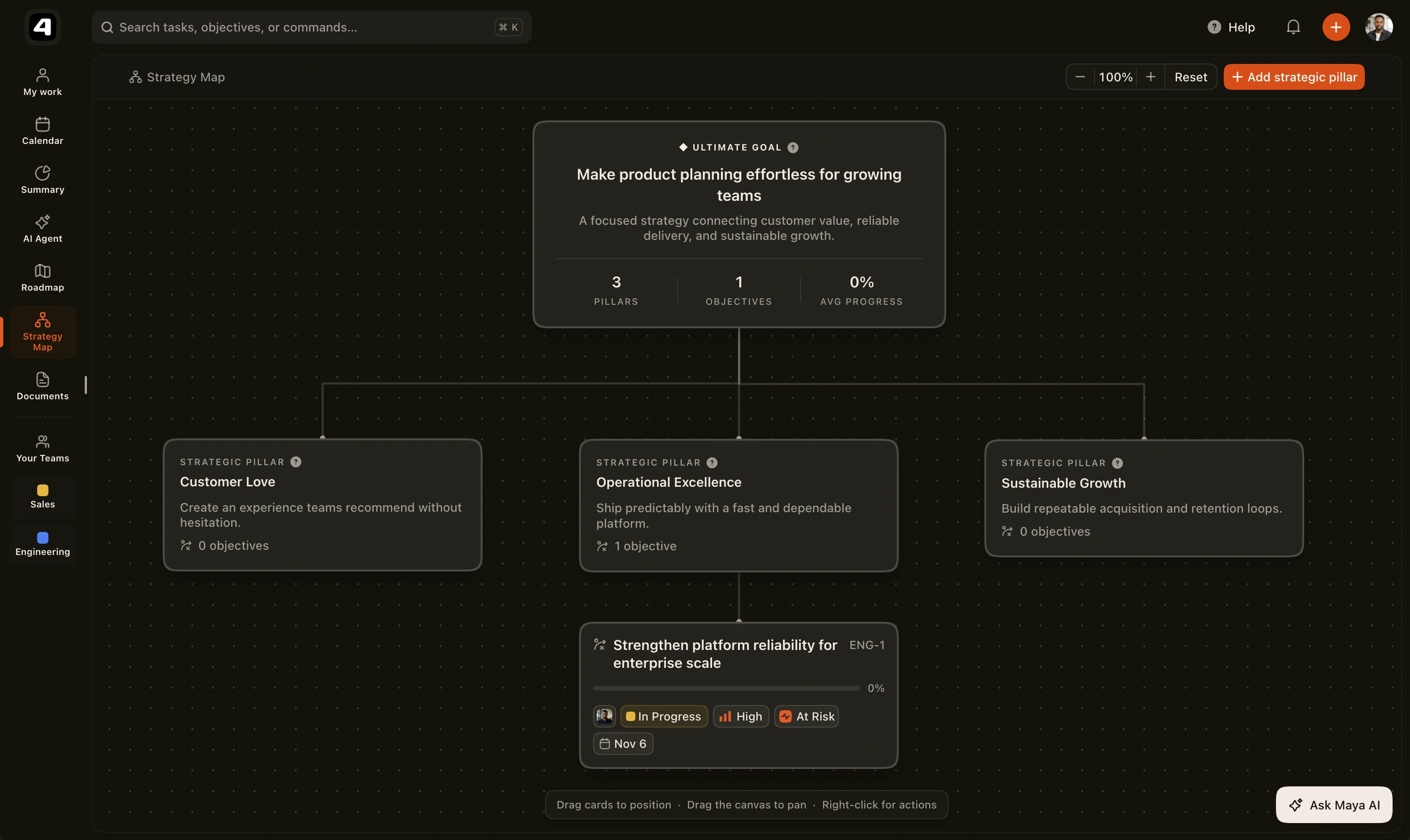
FortyOne solves this challenge by integrating OKRs directly into your project management workflow. When you set Objectives and Key Results in FortyOne, you can seamlessly link them to the Tasks (features, bugs, and projects) your team works on every day. This creates a clear line of sight from strategic goals to tactical execution, ensuring every team member understands how their work drives business outcomes.
Understanding the OKR Framework in FortyOne
What Makes Effective OKRs
Before diving into implementation, it's crucial to understand what makes OKRs effective:
Objectives should be:
- Ambitious and inspiring
- Qualitative and memorable
- Time-bound (typically quarterly)
- Aligned with company vision
Key Results should be:
- Specific and measurable
- Aggressive yet achievable
- Limited in number (3-5 per objective)
- Outcome-focused, not activity-focused
FortyOne is built around these principles, providing an integrated suite of tools that help you "align your team around shared outcomes" and track progress towards your strategic ambitions.
How FortyOne Enhances Traditional OKRs
Traditional OKR tools often exist in isolation, requiring manual updates and offering limited visibility into actual work progress. FortyOne changes this by:
- Connecting Strategy to Execution: Link Objectives directly to the Tasks your team is working on
- Real-Time Progress Tracking: Automatically calculate progress based on linked work completion
- Team-Based Organization: Assign Objectives to specific teams while maintaining cross-functional visibility
- Flexible Measurement: Support for number, percentage, and boolean Key Results to accommodate different success metrics
Creating and Managing Objectives in FortyOne
Setting Up Your First Objective
Creating an Objective in FortyOne is designed to be intuitive while capturing all necessary strategic context. Here's how to set up an effective Objective:
-
Navigate to Objectives: Access the Objectives page from the main sidebar or use the
Shift + Okeyboard shortcut for quick creation. -
Define Your Objective: When the "New Objective" dialog appears, start with a clear, ambitious title. Examples of well-structured Objectives include:
- "Increase user retention by 20%"
- "Establish market leadership in enterprise segment"
- "Launch successful mobile product experience"
-
Add Strategic Context: Use the description field to provide additional context about why this Objective matters and how it aligns with broader company goals.
-
Configure Key Properties:
- Status: Start with "To Do" and progress through "Started" to "Achieved"
- Priority: Set appropriate urgency (No Priority, Low, Medium, High, Urgent)
- Lead: Assign a responsible owner who will drive the Objective forward
- Timeline: Set Start Date and Target Date to create urgency and accountability
Team Assignment and Visibility
FortyOne allows you to associate Objectives with specific teams while maintaining organization-wide visibility. This ensures:
- Focus: Teams can concentrate on Objectives most relevant to their work
- Alignment: Team efforts contribute to broader organizational goals
- Clarity: Clear view of team responsibilities and performance
When viewing Objectives, you can filter by team to see only relevant goals, or view all Objectives to understand cross-functional dependencies and alignment.
Managing Objective Lifecycle
As your Objective progresses, FortyOne provides several ways to track and update its status:
- Health Indicators: Mark Objectives as "On Track," "At Risk," or "Off Track" to communicate current status
- Priority Adjustments: Update priority levels as business conditions change
- Timeline Modifications: Adjust target dates based on new information or changing circumstances
- Progress Monitoring: View overall completion percentage based on linked Key Results and Tasks
Defining and Measuring Key Results
Creating Measurable Key Results
Key Results are the heart of the OKR framework—they transform ambitious Objectives into specific, measurable outcomes. In FortyOne, Key Results are "specific, measurable outcomes that define what success looks like for your Objectives."
When creating Key Results directly within an Objective, you can:
-
Choose Measurement Type:
- Number: For metrics like "Increase monthly active users from 10,000 to 15,000"
- Percentage: For rates like "Achieve 95% customer satisfaction score"
- Boolean: For binary outcomes like "Launch new mobile app"
-
Set Baseline and Target Values:
- Starting Value: Current state or baseline measurement
- Target Value: Desired end state that indicates success
-
Link to Broader Strategy: Ensure each Key Result directly supports the parent Objective
Examples of Effective Key Results in FortyOne
See example objectives and key results
For Product Development Objective: "Launch Successful Mobile Experience"
| Key result | Measurement | Target |
|---|---|---|
| App store rating | Number | 0 → 4.5+ stars |
| First-quarter downloads | Number | 0 → 50,000 |
| Complete mobile onboarding | Boolean | False → True |
For Growth Objective: "Expand Enterprise Market Presence"
- Increase enterprise revenue by 40% (Percentage: 0% → 40%)
- Close 25 new enterprise deals (Number: 0 → 25)
- Launch enterprise security certification (Boolean: False → True)
Updating Key Result Progress
FortyOne supports both manual and automated progress updates:
- Manual Updates: Team leads can update Key Result progress based on external metrics, surveys, or business intelligence data
- Automated Calculation: When Key Results are linked to Tasks, progress can automatically update based on task completion
- Regular Reviews: Use built-in progress tracking to conduct weekly or monthly Key Result reviews
- Objective
Name the outcome the team wants to change.
- Key result
Choose how you will measure progress.
- Task
Define the next piece of work and its owner.
Linking Tasks to Objectives: Connecting Strategy to Execution
The Strategic-Tactical Bridge
The most powerful feature of FortyOne OKRs is the ability to link your day-to-day work (Tasks) directly to strategic goals (Objectives and Key Results). This creates transparency and ensures that teams can "break down the work needed to achieve those KRs into Tasks."
How to Link Tasks to Objectives
-
During Task Creation: When creating a new Task, use the Objective property to directly link it to a relevant goal
-
From Objective View: Navigate to an Objective's detail page and view the "Tasks" tab to see all linked work items
-
Bulk Linking: Use filters and bulk operations to link multiple existing Tasks to newly created Objectives
-
Cross-Functional Support: Teams can link their own Tasks to Objectives owned by other teams, supporting cross-functional goal achievement
Best Practices for Strategic Linking
Link Strategically, Not Everything: Not every Task needs to link to an Objective. Focus on work that directly contributes to Key Results.
Use Hierarchical Linking: Break down complex Objectives using Sub-Tasks to create clear work breakdown structures:
- Objective: "Launch Mobile App"
- Key Result: "Complete core feature development"
- Task: "Implement user authentication"
- Sub-Task: "Design login interface"
- Sub-Task: "Build API integration"
Regular Review and Cleanup: Periodically review linked Tasks to ensure they still align with current Objectives and remove outdated connections.
Visualizing Work Impact
When Tasks are properly linked to Objectives, FortyOne provides powerful visibility into how daily work drives strategic outcomes:
- Objective Progress: Automatically calculated based on completion of linked Tasks
- Team Contribution: See which teams are contributing most to specific Objectives
- Work Distribution: Understand resource allocation across different strategic priorities
- Bottleneck Identification: Identify when Task delays might impact Key Result achievement
Tracking Progress and Driving Results
Real-Time Progress Monitoring
FortyOne transforms OKR tracking from a quarterly exercise into continuous strategic management. The platform provides multiple ways to monitor progress:
Objective Dashboard Views:
- Progress Bars: Visual indicators showing completion percentage for each Objective
- Status Indicators: Clear markers for "On Track," "At Risk," and "Off Track" Objectives
- Key Result Completion: Detailed breakdown of progress toward each measurable outcome
- Linked Task Status: Real-time view of supporting work completion
Team-Specific Views:
- Filter Objectives by team ownership to focus on relevant goals
- View team contribution to cross-functional Objectives
- Monitor workload distribution across strategic priorities
Conducting Effective OKR Reviews
Regular OKR reviews are essential for maintaining focus and driving results. FortyOne supports structured review processes:
Weekly Check-ins:
- Update Key Result progress based on latest data
- Review linked Task completion and identify blockers
- Adjust health status if circumstances change
- Communicate updates to stakeholders through comments
Monthly Deep Dives:
- Analyze progress trends and velocity
- Identify successful strategies for replication
- Address systemic blockers affecting multiple Key Results
- Reallocate resources based on changing priorities
Quarterly Reviews:
- Score final Key Result achievement (typically 0-1.0 scale)
- Document lessons learned and successful practices
- Set new Objectives for the upcoming quarter
- Archive completed Objectives while preserving historical data
Using Data to Drive Decisions
FortyOne provides rich data to inform strategic decisions:
Progress Analytics:
- Identify which Objectives consistently achieve targets
- Understand team velocity and capacity for strategic work
- Recognize patterns in successful Key Result types
- Track improvement in OKR achievement over time
Resource Allocation Insights:
- See how Task completion translates to Objective progress
- Identify teams or individuals contributing most to strategic goals
- Understand time allocation across different Objective categories
- Plan future resource needs based on historical achievement data
Advanced OKR Strategies in FortyOne
Cascading Objectives Across Teams
For larger organizations, FortyOne supports cascading OKRs from company level to team level:
- Company Objectives: Set high-level organizational goals
- Department Objectives: Create supporting goals that roll up to company Objectives
- Team Objectives: Define specific team goals that contribute to department success
- Individual Objectives: Align personal goals with team and company priorities
Cross-Functional Objective Management
Many strategic goals require coordination across multiple teams. While each Objective, Task, and Sprint belongs to a single team in FortyOne, cross-functional coordination is facilitated through:
- Multiple Team Contributions: Different teams can each create their own Tasks that link to and support the same Objectives and Key Results
- Unified Progress Tracking: View how multiple teams contribute to single Objectives through their respective team's linked Tasks
- Coordinated Planning: Teams can align their individual Sprint planning to work toward the same strategic outcomes
- Clear Ownership: Each Objective, Task, and Sprint has one accountable team while enabling coordinated effort across teams
Integration with Sprint Planning
FortyOne seamlessly connects OKR planning with Sprint execution:
- Objective-Driven Sprint Goals: Set Sprint goals that explicitly support Key Results
- Progress Validation: Use Sprint reviews to assess Key Result advancement
- Priority Alignment: Ensure Sprint backlog prioritization reflects Objective importance
- Velocity Tracking: Understand how Sprint velocity impacts Objective timeline achievement
Measuring Success: OKR Metrics That Matter
Key Performance Indicators for OKR Programs
Beyond individual Objective achievement, monitor these program-wide metrics:
Achievement Rates:
- Target 70% average Key Result achievement (indicating appropriate stretch goals)
- Track improvement in achievement rates over time
- Monitor distribution of scores across teams and Objective types
Engagement Metrics:
- Percentage of team members with linked Tasks to Objectives
- Frequency of progress updates and comments
- Usage of OKR views and dashboards
Business Impact:
- Correlation between OKR achievement and business metrics
- Time from Objective setting to Key Result achievement
- Resource efficiency in strategic goal attainment
Common Pitfalls and How FortyOne Helps Avoid Them
Pitfall 1: OKRs Become Set-and-Forget
- Solution: Real-time progress tracking and automated reminders keep OKRs visible
Pitfall 2: Disconnect Between OKRs and Daily Work
- Solution: Task linking ensures every strategic goal has supporting tactical execution
Pitfall 3: Too Many or Too Complex Objectives
- Solution: Clear prioritization and progress visualization help maintain focus
Pitfall 4: Lack of Team Buy-In
- Solution: Collaborative creation and transparent progress sharing build ownership
Conclusion: Transforming Strategy Execution with FortyOne OKRs
Implementing OKRs in FortyOne transforms how your team approaches strategic planning and execution. By connecting high-level Objectives to specific Key Results and linking both to the Tasks your team works on daily, you create unprecedented alignment between strategy and tactics.
The key benefits of FortyOne OKR implementation include:
- Strategic Clarity: Every team member understands how their work contributes to company goals
- Real-Time Visibility: Progress tracking reveals achievement patterns and potential issues early
- Resource Optimization: Clear priority alignment ensures effort focuses on highest-impact work
- Continuous Improvement: Regular reviews and data analysis drive better goal-setting over time
- Team Engagement: Transparent progress and collaborative planning build ownership and motivation
Ready to align your team around strategic objectives? Start by setting your first Objective in FortyOne and experience how integrated OKR management transforms strategy execution.